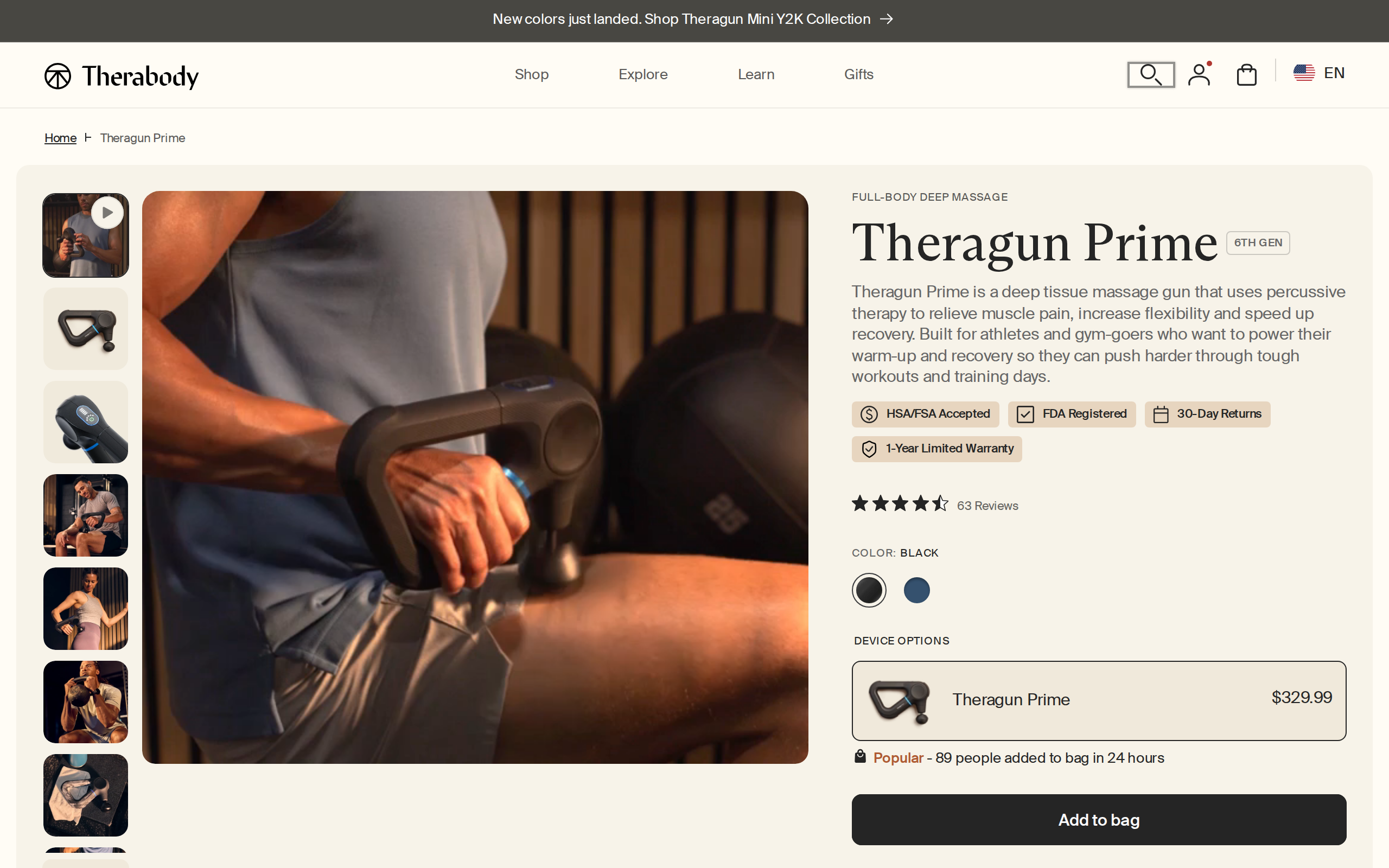
Theragun Prime (6th Gen) Review: The Massage Gun Most Lifters Should Buy
By The Ironnook Test Desk ·
7.7
therabody.com
The verdict
The Prime gives you the same 16 mm stroke as the dearer Theragun models for $329.99, with a long battery and a triangular handle that reaches your back. It is not quiet, the stall force is modest, and it has only two attachments. For most home lifters it is the right Theragun, but not the best massage gun per dollar.
Best for: Home lifters who want deep percussion without Pro prices
What we liked
Full 16 mm amplitude at a price well below the Pro
Up to 120 minutes of battery, charged over USB-C
One-button control with five speeds and a pressure readout
Triangular handle reaches the upper back and glutes
Light enough at 32 oz to use for 10 minute sessions
What could be better
Measured noise of roughly 59 to 69 dB is louder than rivals
The Hypervolt 3 Pro is the massage gun we would hand to someone who dislikes the racket of most percussion tools. It is quiet, rated at 70 lb of stall force against about 30 lb for the Theragun Prime, lasts around four hours on a charge and includes a heated head. The cost is a 14 mm stroke that goes less deep than Theragun's 16 mm, and a price $20 higher than the Prime. For most lifters it is the better buy.
Normatec 3 Legs are well built, quiet and easy to run, and they do take the edge off leg soreness. The research says that edge is small, mostly perceptual, and it costs $899. They make sense for high-mileage runners and cyclists with a recovery habit. A lifter training three days a week should buy a foam roller and a massage gun first.
Full 16 mm stroke, five speeds, two hours of battery and a $329.99 price. We checked the specs and independent tests to see where Therabody's middle child saves money and where it cuts corners.
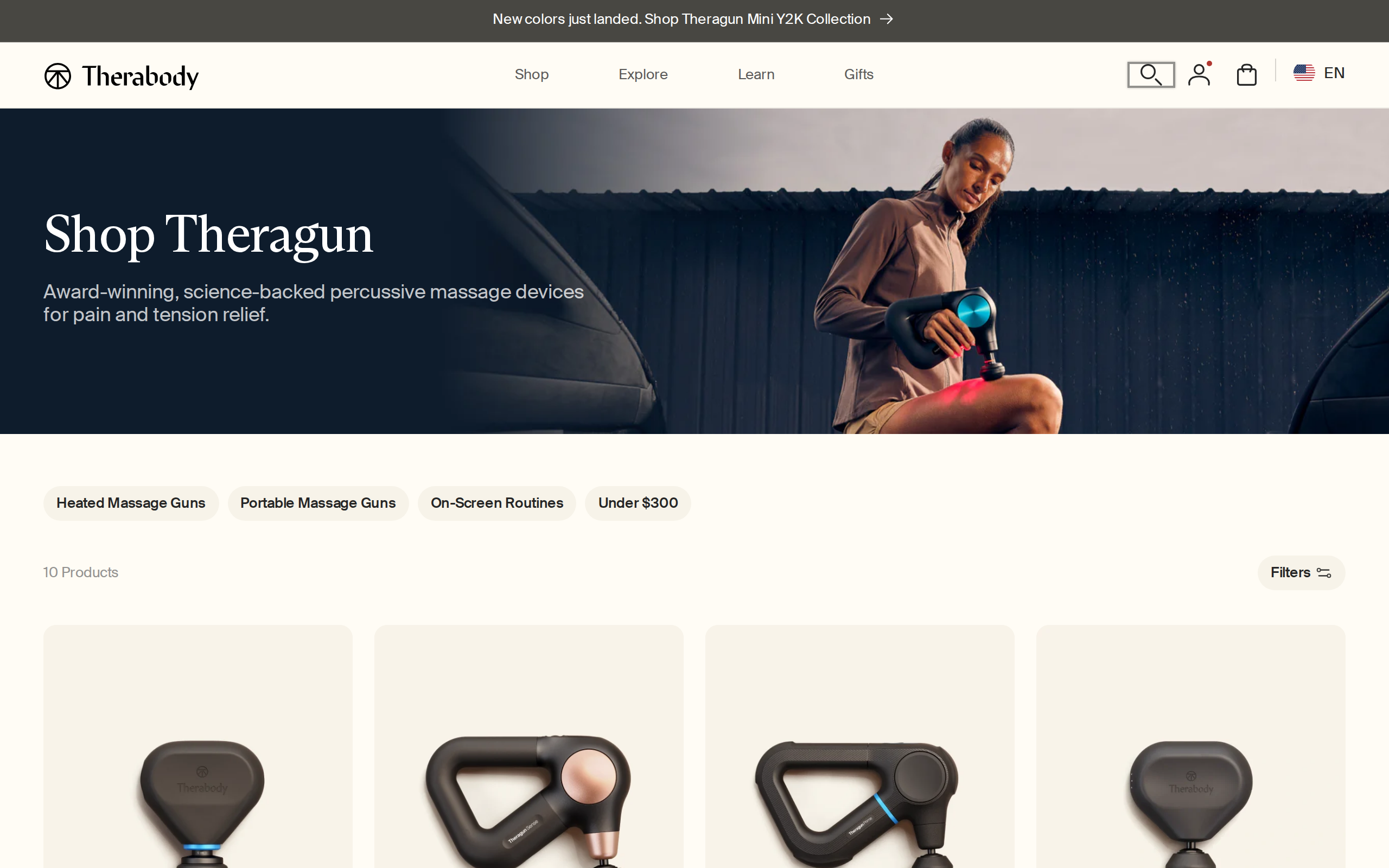
Therabody sells ten Theraguns. For a person who lifts three or four days a week, nine of them are either too small, too fancy or too expensive. The Prime is the one in the middle, and it is the one we would tell a friend to look at first.
What you get for $329.99
The Prime (6th generation) costs $329.99. For that the box holds the gun, a dampener attachment, a standard ball and a USB-C cable. That is the whole kit. There is no travel case worth the name and no extra heads for the feet or spine.
The numbers that matter come from Therabody and from independent testers. Stroke depth is 16 mm, which is the same figure printed on the pricier models. Five speeds run from about 1,750 to 2,400 percussions a minute. Therabody quotes up to 120 minutes of battery. It weighs 32 oz (907 g) and measures 238 by 153 by 61 mm, so it fits a gym bag.
Where the Prime sits in the family
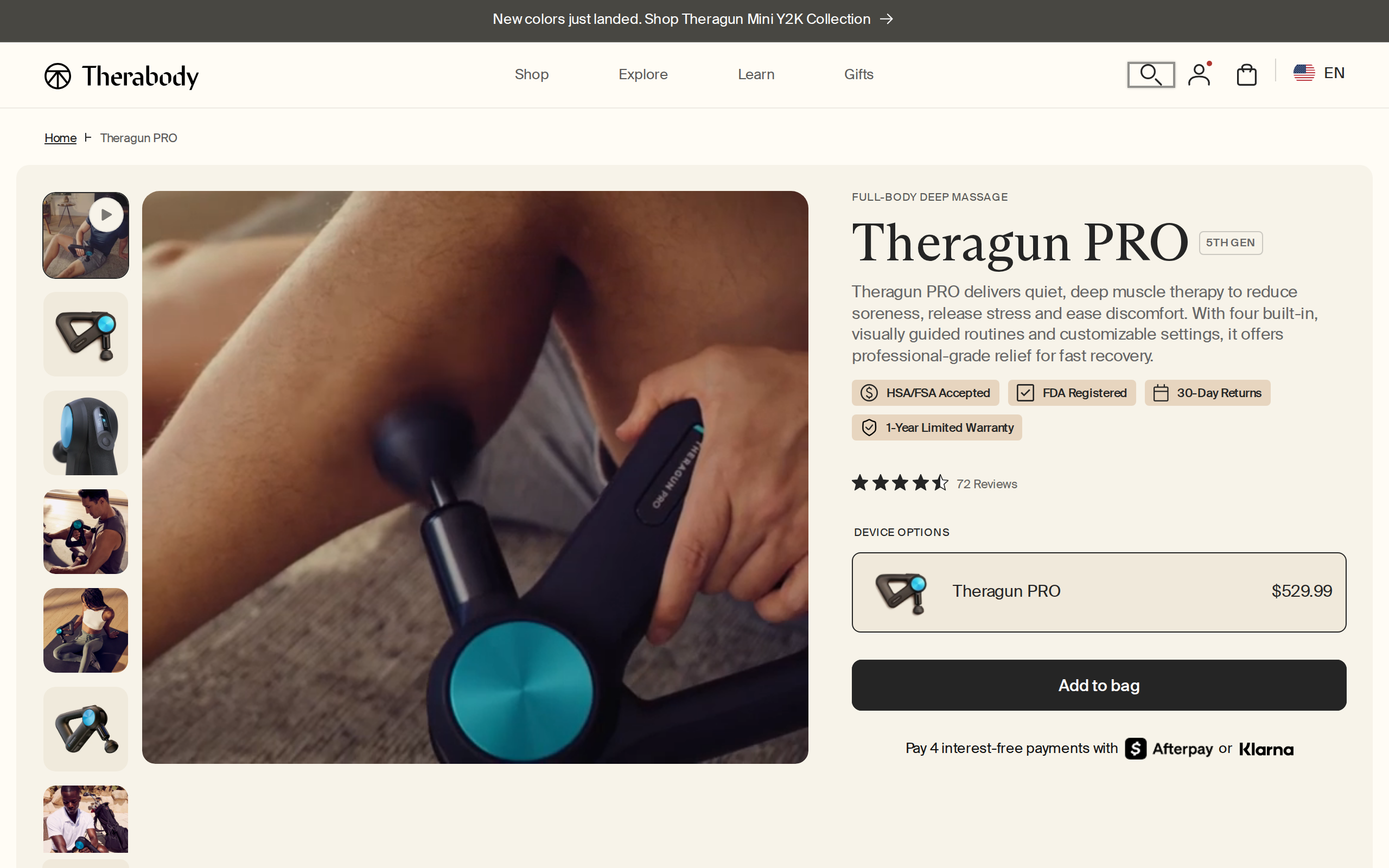
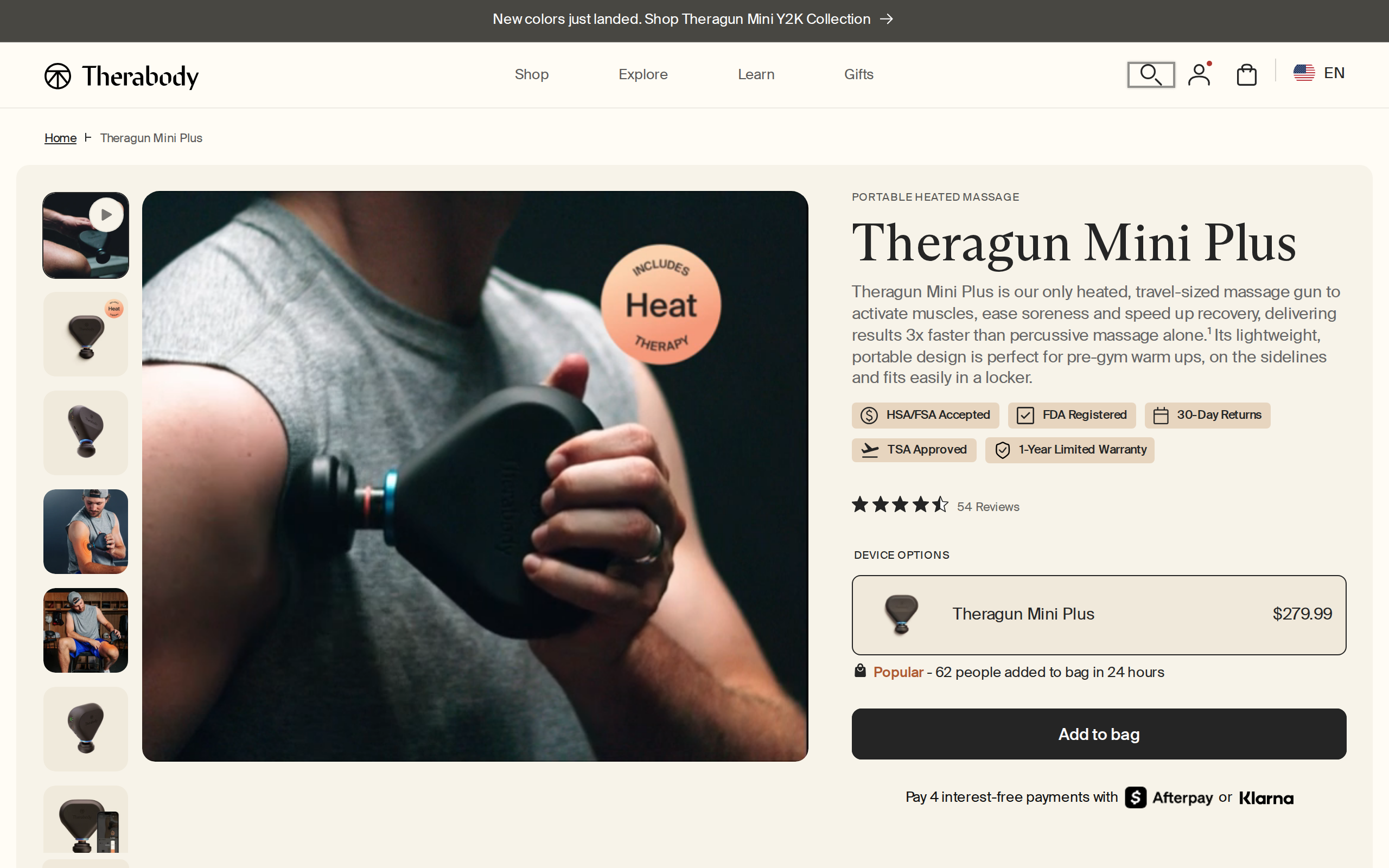
Look at the lineup page and the logic is clear. The Pro costs $529.99 and the heated Mini Plus is $279.99.
The Theragun range at Therabody, ten products from travel size up to the Pro.
The Pro buys you more power, a rotating arm and extra attachments. If you massage other people, or you are a big athlete with dense quads, that gets you somewhere. For one person who rolls out after squats, it is a lot to pay.
The Theragun Pro, at $529.99, the gun the Prime is most often compared with.
The Mini Plus is smaller and heated, and it is the better choice for a travel bag or a desk drawer. It is not the one for hamstrings after deadlifts.
The Mini Plus, Therabody's heated travel-size model at $279.99.
The noise and stall problems
Here is where the Prime asks for compromises. Independent testers put the noise at about 59 to 69 dB. That is a household vacuum at the top end, and it is louder than the Sense and louder than Hyperice's Hypervolt. Therabody's own buyers call it comfortable enough for TV, and that fits our read: tolerable alone, annoying in a shared room.
Stall force is the other soft spot. At roughly 30 lb, the motor slows when you lean hard into a glute or quad. The 16 mm stroke is the headline, but a stroke that stalls does less than one that does not. Press lightly and let the gun work, and it is fine. Fight it and it bogs down.
The pressure readout helps here. A light ring shows how hard you are pushing, so you learn to stop at the point where the speed drops. That alone makes it friendlier than a plain on and off device.
Using it week to week
One button is the whole interface. Hold to power on, tap to step through five speeds. The Therabody app adds guided routines, but you do not need it to use the gun. We would use speed two for warm-ups and four for post-session work, and keep the dampener on for bone-adjacent spots like the shoulder blade.
The triangular handle is the best thing about the Prime. It lets you hit the upper back without dislocating something, and the 32 oz weight means your arm survives ten minutes. Battery claims of two hours are enough for weeks of short sessions between charges.
The attachments are where we would spend a little more. The dampener softens the blow on bony areas and sore tendons, and the ball does everything else. Buyers who want a flat head for big muscle groups or a bullet for knots in the foot have to buy another gun or an add-on. Therabody covers the Prime for one year, which feels thin for a $330 tool that gets thrown in a gym bag.
A note on claims: percussive massage can ease soreness for a while, but it is not a treatment. If something hurts for more than a few days, see a clinician, not a gadget.
Verdict
The Prime is the right buy if you want real depth, a long battery and a proper handle, and you can live with the volume. If you share a small space with someone who sleeps, or you want heat, quiet or a travel size, look elsewhere. If you need harder pressure on thick muscle, save for the Pro.
We give the Prime a 7.7. It is the Theragun most home lifters should buy, though not the cheapest way to get a decent massage gun.
The Go 3 is a quiet, light, well-priced massage gun that handles calves, forearms, shoulders and upper back without fuss. Its stall force runs out on big quads and glutes, so a lifter who trains legs hard should pair it with a bigger gun or buy the Hypervolt 3 Pro instead.